Blazing UFS 5.0 Speeds: Here’s What You Need to Know
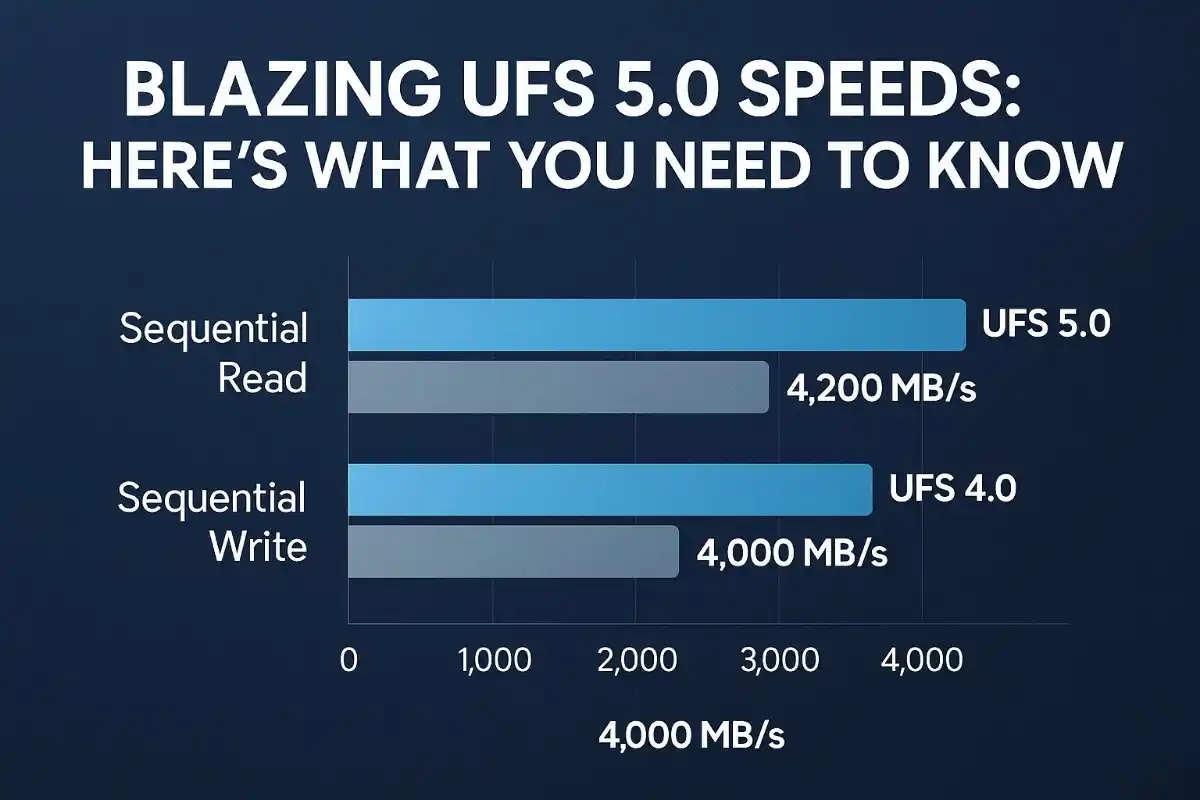
UFS 5.0 is a universal (UFS) flash storage (FS) system that is in the development stage. JEDEC officially set the data rate per lane as 46.4 Gbps; hence, it can achieve 2x UFS 4.0 per lane speed of 23.2 Gbps (4×2.) With the help of new PAM3 signalling, the peak sequential read speed can go up to 3.3 GB/s, while write speeds can exceed 2.6 GB/s. These speeds are comparable to the high-end NVMe SSDs in PCs.
Moreover, UFS 5.0 has the capability of full duplex, which means the device can perform simultaneous read and write operations at full bandwidth; thus, there will be no loss of data transmission. As well, UFS 5.0 has the power conservation features of selective power modes and better heat dissipation that extend battery life even at full loads.
Top 5 End User Benefits
1. Quicker App Launch and File Transfer
Table of Contents
UFS 5.0 ultra-fast read speeds let users open apps almost immediately, and transferring large files such as high-resolution photos and videos becomes a matter of a few seconds rather than minutes. Camera previews are almost instantaneous, production of live previews in editing apps becomes smooth, and data synchronisation to cloud services is rapid.
2. Excellent Multitasking and Gaming
There is no performance loss in full duplex mode; thus, background tasks like system updates or cloud backups of the process do not interfere with foreground activities such as gaming or streaming. Gamers can witness the texture pop in diminishing, and power-level loading becomes faster, making it possible to have almost no asset streaming time, achieving a very close to zero latency effect; thus, playing at the level of consoles but on mobile hardware.
3. The Growth of AI and ML Performance
The growing environment of smart devices that includes smartphones and wearable gadgets has a high reliance on on-device AI. UFS 5.0, which is fast and has low latency, speeds up AI workloads and AI applications in real time, such as face recognition, language translation, and camera scene detection, which become both faster and more accurate, thus generating more comfortable user experiences without having to be done on the cloud.
4. Efficient Thermal and Power Usage
The dynamic data lanes are smart and change the power state according to the workload; thus, the energy draw is minimal during periods of idleness or when it is under light usage. The preliminary performance tests show 20% less consumption in battery compared to UFS 4.0. during heavy reading and writing, as well as the devices’ surface temperatures remain lower, thus providing the users with comfort and the components with durability.
5. Ready for the Future
The extra bandwidth that comes with UFS 5.0 allows for the development of future applications such as 8K video recording at high frame rates, live cloud gaming, and mobile VR/AR. The manufacturers can come up with thinner devices that require less cooling hardware and rely on the energy efficiency of UFS 5.0 to take care of the data that comes at the highest rates.
How UFS 5.0 Compares to Other Storage Types
| Feature | UFS 5.0 | UFS 4.0 | eMMC 5.1 | NVMe SSD (PCIe 3.0) |
|---|---|---|---|---|
| Sequential Read (Max) | 3.3 GB/s | 2.9 GB/s | 250 MB/s | 3.5 GB/s |
| Sequential Write (Max) | 2.6 GB/s | 1.8 GB/s | 125 MB/s | 3.0 GB/s |
| Full-Duplex Support | Yes | No | No | Yes |
| Power-Saving Modes | Advanced | Basic | Limited | Varies |
| Typical Use Case | Flagship smartphones | High-end smartphones | Budget/mid-range devices | Laptops, desktops |
Devices and Chipsets Leading the Charge
There are several late 2025 flagship chipsets announced that support UFS 5.0 without any problem from the very first point, such as:
- Snapdragon 8 Gen 4: The S.o.C. of the next flagship of Qualcomm will be one with not one but two UFS 5.0 lanes; thus, the best Android mobile phones will be the target of it.
- Exynos 2500: The new platform of Samsung for the Galaxy series with the combination of UFS 5.0 and LPDDR5X RAM will set the camera and AI features as the main focus of the product.
- Tensor G4: Based on the announcements, Google is expected to combine UFS 5.0 with its home-brewed chip for the Pixel 10 series to have the best performance in AI inference and computational photography.
Articles by Xiaomi, OnePlus, and Vivo insiders reaffirm that one can expect UFS 5.0 models in their first quarter 2026 flagship releases. The price is anticipated to remain modest thanks to the gradual decreasing of production costs.
Real World Impact: Early Benchmarks
UFS 5.0 technology is proven by independent benchmarking to result in a 10% quicker boot sequence, 15% faster game loading, and up to 18% less storage-related lag during high-intensity application usage when compared to UFS 4.0 devices. Thus, buyers who intend to upgrade to these gadgets will notice the devices speed up their daily chores to a certain extent, which is important as smartphones get closer to hitting performance limits elsewhere.
What Consumers Should Consider
When judging a purchase:
- Check Storage Version: The manufacturers will use tags like “UFS 5.0” or “UFS 5.0+”, clarifying that the latter has more features than the standard one, and the rest can be used for future implementation; it will be necessary to verify the devices by checking the specifications.
- Storage Capacity: Writing performance is higher as space gets larger (above 256 GB) because most of the data areas are being written simultaneously due to parallelism.
- Complementary Components: A better result of total system speed is gained if one uses UFS 5.0 in combination with at least 8 GB LPDDR5X.
- Software Support: Only apps that are designed for lowering overhead and maximising the real speed gains can unlock the benefits of UFS 5.0, including duplex transfers and low-latency modes in your operating system.
Moving Forward
UFS 5.0 redefines standards of the storage world, but the industry’s excitement about what lies ahead, like UFS 5.1 and beyond, which might feature things like encryption offloads and more lanes, has not died out yet. Therefore sporting UFS 5.0 today is the same as having top-tier storage speed for all of your activities, be they gaming marathons or AI-driven creative work.
To sum it up, one can say that extremely fast UFS 5.0 transfer rates make operating systems very responsive, efficient and future-safe. Those who first go for it will get a more seamless, faster yet less power-hungry smartphone lifestyle and at the same time will be part of the next leap in mobile innovation.