Vivo X300 Series India Debut: What’s Really New Here
It’s been a long month of holding back the urge to buy for the Indian people who love smart gadgets. Globally there has been a lot of buzz and a lot of talking, but finally, Vivo is bringing the flagship X300 series to India on the 2nd of December 2025 at 12 PM IST, which is a major change in the company’s premium segment strategy.
We can watch the launch (which will be livestreamed on Vivo’s official YouTube channel and social media platforms) not only of one but of two powerhouse devices, the Vivo X300 and the Vivo X300 Pro, both of which have been designed to transform the Indians’ way of mobile photography and performance.
What Makes the X300 Series Stand Out in India’s Premium Market
Compared to previous launches, Vivo decided to bring a few exclusive products to Indian consumers that make this range of products extremely attractive. There will be an exclusive Summit Red color variant of the standard Vivo X300 only in India, which is a very clever move to make the Indian launch more exclusive. Meanwhile, the X300 Pro comes in two colors, Dune Brown and Phantom Black, which are perfect for those who want a professional look.
Table of Contents
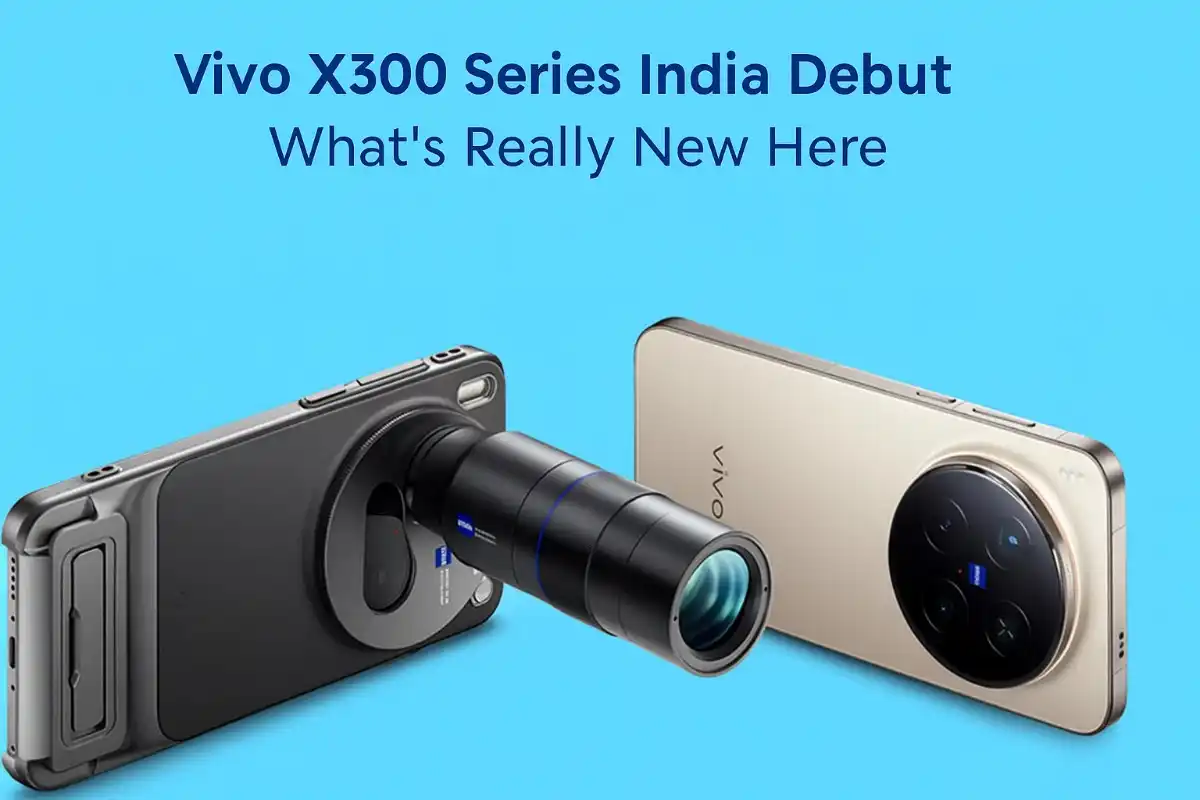
One of the most significant points of the release, arguably, is the Vivo ZEISS 2.35x Telephoto Extender Kit, which is an absolute dream accessory for any photographer, and it completely changes the imaging capabilities of the phone. This state-of-the-art photography instrument, which takes its components from a professional camera, will be available as a separate purchase and enables users to have an extended zoom similar to that of a dedicated camera rig.
Content creators, travel photographers, and mobile cinematographers can hardly believe that this is actually happening; it is a game-changing addition to smartphone accessories in India.
Display and Design: Flagship Excellence in Compact Form
The Vivo X300 is equipped with a stunning 6.31-inch flat LTPO AMOLED display with 1.5K resolution (1216 x 2640 pixels) that results in a pixel density of 1260 PPI. Such a small size makes it one of the most portable flagship phones out there and is thus very attractive to people who are looking for comfortable and one-handed use. The display has an adaptive refresh rate of 120 Hz, which is controlled by the latest 8T LTPO backplane technology together with ZEISS Natural Color Solution for color accuracy.
The smaller Vivo X300 Pro comes with a larger 6.78-inch display with the same resolution and refresh rate, but the user gets a more immersive viewing experience for watching videos and playing games. Both are equipped with a maximum brightness of 4,500 nits, which makes it very easy to read the text on the display even in bright sun, and this is supported by a very accurate color grading system that still allows for 100% P3 wide color gamut coverage to be used.
Both the Vivo X300 and Vivo X300 Pro are rated IP68 and IP69, indicating that they are totally resistant to dust and may be submerged in water up to a depth of 6 meters and are thus able to resist high-pressure water jets, a feature that is very rare in this type of device and which thus considerably increases the lifespan of the new generation of flagships.
The Photography Revolution: Where the X300 Series Really Shines
The core of the Vivo X300 series is its brilliant camera capabilities, which was one of the prompts to partner with the famous lens-making company ZEISS. The collaboration goes far beyond mere product branding; it shows that the company is deeply committed to providing the best in optical quality, something that really differentiates these phones from others on the market.
The Vivo X300 is outfitted with a triple camera system that defiantly pushes the limits of a normal compact flagship. The primary 200-megapixel main sensor with OIS (optical image stabilization) is capable of extraordinary detail, while a 50-megapixel periscope telephoto lens is able to give 3X optical zoom and 100X digital zoom.
A 50-megapixel ultra-wide camera is the third member of the triple camera system; thus, the combination is suitable for the photographer taking shots under any circumstances. All the sensors are tuned by ZEISS, so aberration control and color science of a professional level are ensured for all focal lengths.
If we talk about the Vivo X300 Pro, the device doesn’t just offer the ultimate camera experience; it is the camera itself that is reversed: the primary sensor comes last, a 50-megapixel Sony LYT 828 gimbal-grade main sensor with f/1.57 aperture and CIPA 5.5 stabilization is on top, and one can say a DSLR-grade stabilization is here compacted into a smartphone.
Alongside it is packed with a groundbreaking 200-megapixel ZEISS APO telephoto lens providing 3.5X optical zoom and up to a very high 100X digital zoom, with autofocusing being facilitated by the machine learning model for birds and flowers. The 50-megapixel ultra-wide Samsung JN1 sensor completes the premium camera array.
Innovatively, the X300 Pro contains two image processing engines: the V3+ chip and the VS1 chip. The V3+ is responsible for general image processing, while the VS1 enables ultra-performance supercomputing for preprocessing frames that are then quickly delivered and widely scene covered. They have installed this technological backup to make sure faster imaging pipelines and the sought-after computational photography capabilities are achievable.
The X300 series offers the option to shoot “Telephoto Flower & Bird Shots” with AI-powered autofocus, “Multi Focal HD Portrait” with five golden focal lengths (24mm, 35mm, 50mm, 85mm, and 135mm), and “20x Long Range Motion Snapshot” to capture distant moving objects with great detail. Videographers will find it useful as well; the Zeiss Gimbal Grade stabilization feature can be used to keep the video footage smooth and give it a professional look when the conditions are not favorable.
Performance: MediaTek Dimensity 9500 Powers Everything
What is inside the engine? The X300 and X300 Pro, both, are powered by MediaTek’s top-tier Dimensity 9500 chip that is based on TSMC’s very high-end 3nm production process. So for example, the chip has a CPU architecture with all the cores being the biggest ones (1+3+4 layout) that results in the single-core performance going up by 32% as well as the GPU performance going up by 33% at the same time as the generation before the chip is going down.
The device up to now is such that it features a co-processor with the CPU, which is the V3+ NPU for images, co-designed with Vivo, the purpose of which is to make computational photography operations as fast as possible and also to save the battery. Gaming performance is excellent, with the low-power side of things that is usually about 4.5 watts during heavy titles, and the heat control that still manages to keep the device from facing a severe throttle even during long gaming periods. So, the V9500 is extremely good at gaming, and at the same time, it keeps the mobile heated for a very long timeline free.
The memory variations of devices go up to 16GB LPDDR5X RAM, and for storage, fast UFS 4.0 or UFS 4.1 with the size extending up to 1TB can be utilized, thereby making the devices a safe bet for future games and content creators.
Battery and Charging: All-Day Power with Lightning Speed
Battery-wise, the Vivo X300 is equipped with a 5,360 mAh battery, and the Pro variant has a slightly bigger one with 5,440 mAh capacity. Besides that, they both can be charged up to 90W via wired mode and up to 40W via wireless. And moreover, the X300 Pro is equipped with reverse wireless charging, thus giving the possibility of doing the opposite and placing a compatible accessory on which to pick up power if seemingly in an emergency and needing a quick top-up.
These battery sizes are indicative of a great balance between portability and battery life. Through the use of a 90W fast charger, full charges can be achieved in less than an hour, and 40% can be achieved in just 20 minutes, which users on the go would find really helpful.
OriginOS 6: A Fresh Software Experience for India
The use of a completely different OS is the most noteworthy change with the announcement of OriginOS 6 as the latest platform based on Android 16. This is the first time that the Indian market is getting the luxurious OriginOS experience from Vivo, and the change means that the outdated FunTouch OS ecosystem is no longer there. Some of the benefits of the new interface are that it is more fluid, the animations are smoother, personalization options become deeper, and there are AI-centric improvements that are close to Google’s Gemini abilities.
First and foremost, OriginOS 6 features highly advanced AI assistants for predictive language, photo enhancement, and battery management; privacy-featured on-device processing for real-time translation; and environment coordination that makes Vivo wearables, tablets, and PCs seamlessly and vitally connected. The new OS is very particular about the adaptation of refresh rates, and it also learns from the patterns of use to save battery life. E
Availability and Special Offers in India
The X300 series will be open for purchases through various offline and online channels such as Amazon India, Flipkart, Vivo India’s official eStore, and authorized retailers after the December 2 inauguration event. The company strategically positioned this launch post after iQOO 15’s November 26 debut to allow market preparation for two weeks before the grand arrival of the X300.V.
Conclusion: Is This the Photography Phone India Has Been Waiting For ?
The Vivo X300 series is transforming smartphone camera technology in India to a new level. The use of the Zeiss optical hardware, powerful computational photography chips, incredible zoom via the optional Telephoto Extender Kit, and the polished experience of OriginOS 6 all make the devices real challengers of flagship rivals. For professionals in photography, content creators, and enthusiasts who are not willing to compromise on the quality of optics, the December 2 launch is a persuasive reason to consider Vivo’s premium offering.